Top 5 Data Quality Problems AI Agents Can Solve


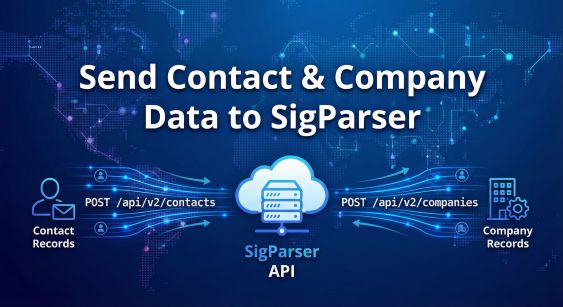
Create a centralized Contact & Company data warehouse with SigParser APIs

In relationship-driven industries, nothing is more valuable than the firm’s network of contacts. That’s why Enterprise Relationship Management (ERM) systems were built, to quietly capture relationship data from everyday activities like emails, meetings, and touchpoints without burdening busy professionals. Now, with the advent of AI and large language models (LLMs), the ERM landscape is shifting dramatically, AI data stewards can deliver accuracy and scale that were previously impossible.
Legacy ERMs cracked the code on automated data capture, pulling contacts and activities directly from email and calendar systems. But they fell short on accuracy. Data stewards had to step in—fixing display names, reviewing email signatures for accuracy, and deleting junk contacts. The work was endless, repetitive, and left firms with data that was never as clean or current as it needed to be.
Now, AI has flipped the script. Modern “AI data stewards,” powered by large language models, can do at scale what once took entire teams. They deliver cleaner, richer, continuously updated data with near-zero manual effort. Instead of scrubbing records, human stewards can focus on higher-value work, unlocking the true potential of ERM.
The Limitations of Traditional ERM
Legacy ERMs, built before the advent of modern AI, had significant limitations:
- Display names extracted from emails often came in inconsistent formats: last name first, alphanumeric strings, or characters unique to internal IT standards. No algorithm could reliably parse every variation.
- Email signature parsing was an early innovation, but accuracy was hampered by the infinite variety of signature layouts and the lack of a global standard.
- Noise from non-person addresses—such as “accounts@” or “info@”—flooded databases with records that weren’t useful for business development.
- Manual review requirements forced firms to employ teams of data stewards to comb through records for accuracy.
- Scalability constraints meant that data was never fully up to date. Human capacity simply couldn’t keep pace with the flow of new contacts and updates.
Despite these challenges, traditional ERMs were still valuable because they replaced the alternative: manual data entry and incomplete databases. The tradeoff was clear: firms gained an order of magnitude more data that was broadly accurate, though rarely perfect, but at the cost of increased dependence on human data stewards to curate it.
Modern AI-Enabled ERM
AI changes the game. LLMs can ingest massive amounts of unstructured data, recognize context, and classify information with near-human accuracy, but at machine scale and speed.
An AI-enabled ERM can:
- Extract first names, last names, email addresses, and company affiliations from messy inputs with near 100% accuracy.
- Continuously update contact and company profiles in real time.
- Identify whether an email address belongs to a real person or a generic inbox.
- Build out accurate job levels and departments, critical for segmentation and targeted outreach.
This automation doesn’t eliminate the role of human data stewards, it elevates it. Instead of spending their days correcting display names, stewards can focus on higher-value initiatives such as refining segmentation models, designing governance frameworks, or enabling business development teams to use the data effectively.
For more info on what to look for in a modern ERM, check out our resource The Complete ERM Checklist for Legal Marketing.
The Top 5 Data Quality Problems AI Solves
- Accurate First & Last Names
LLMs resolve the complexities of display names, no matter the format or language, delivering consistently accurate names without human intervention. Even if a contact does not provide an email signature, AI can provide a correct first/last name, email address and company for each contact. - Email Signature Parsing
AI can reliably extract titles, phone numbers, and addresses from even the most inconsistent email signatures. This means human data stewards no longer need to spend time reviewing email signatures for accuracy. - Identifying Non-Person Contacts
AI distinguishes “support@company.com” from “jane.doe@company.com,” preventing non-person records from polluting databases. - Job Level Classification
AI groups contacts into seniority tiers, C-level, Director, Manager, Contributor, making segmentation for campaigns straightforward. - Department Classification
AI categorizes job titles into functions like Marketing, Sales, or Operations, enabling precise targeting such as “senior executives in sales.”
The New Standard
These five capabilities represent just the beginning. Modern AI data stewards are not a “nice-to-have”, they are essential for any firm that wants accurate, complete, and real-time contact data.
ERM vendors that do not incorporate AI stewarding will continue to require heavy manual effort, leaving firms with stale and incomplete records. In contrast, AI-enabled ERM allows firms to trust their data, act on it in real time, and repurpose human data stewards onto strategic initiatives.
The future of ERM is not more humans reviewing records; it is AI delivering accuracy at scale and humans driving value with that data. Any ERM solution under evaluation today should be judged by this standard.